
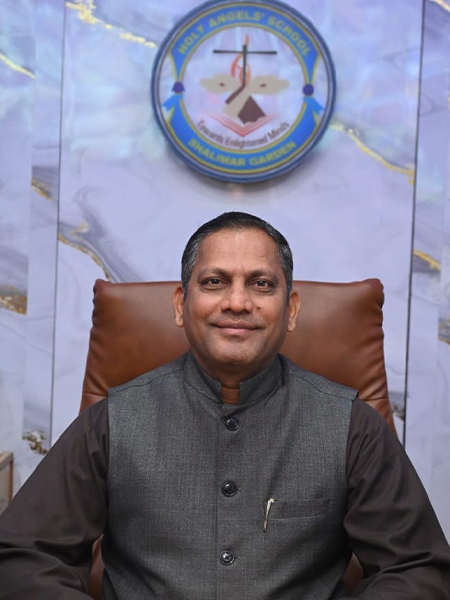
First of all, I sincerely thank our teachers, parents, students and well-wishers for making this academic year a great success. Your support, dedication and encouragement mean a lot to me. I am truly grateful.
“The future depends on what you do today,” says Mahatma Gandhi. It is a simple truth, yet one that echoes across time. When i ask myself who holds tomorrow, I am not merely asking about power, but about preparedness—intellectual, ethical, social, and professional. Education stands at the heart of this preparedness, shaping individuals who will carry the weight of tomorrow on their shoulders.
From a technological perspective, tomorrow belongs to those who can understand and innovate. We live in an age where ideas turn into inventions overnight, and knowledge evolves at lightning speed. Education equips individuals with digital literacy, critical thinking, and adaptability—skills essential in a world driven by artificial intelligence, automation, and constant change. As Alan Kay famously said, “The best way to predict the future is to invent it.” Those who are educated in technology do not fear the future—they design it.
If the future is driven only by machines, there is risk of losing its humanity. This is where the moral perspective becomes vital. Education is the compass that guides individuals toward what is right and just. It teaches that progress without ethics is perilous. Knowledge must walk hand in hand with conscience. As Martin Luther King Jr. once said, “Intelligence plus character—that is the goal of true education.” Tomorrow, therefore, belongs not only to the intelligent but to the morally grounded—those who choose integrity over convenience and compassion over indifference.
From a social perspective, education binds individuals into a cohesive and empathetic society. It nurtures respect for diversity, encourages dialogue, and fosters unity in a fragmented world. A truly educated person does not live in isolation but contributes to the well-being of others. Nelson Mandela believed that “Education is the most powerful weapon which you can use to change the world.” This change is not merely technological or economic—it is deeply social.
Tomorrow is held by those who can uplift communities, bridge divides, and build inclusive societies.
On the professional front, education transforms potential into capability. It prepares individuals not just to earn a livelihood, but to excel, innovate, and lead in their chosen fields. In a competitive world, professionalism demands not only skill but also discipline, adaptability, and lifelong learning. The workplace of tomorrow will not reward static knowledge but continuous growth. Those who embrace learning as a lifelong journey will remain relevant and resilient.
When these perspectives intertwine, a powerful truth emerges: the future is not shaped by one dimension alone. A technologically skilled but morally indifferent individual can harm society; a socially aware but professionally unprepared individual may struggle to contribute effectively. It is the balance—of knowledge, ethics, empathy, and expertise—that truly holds tomorrow.
As a conclusion, tomorrow belongs to the educated individual who is technologically adept, morally conscious, socially responsible, and professionally competent. Education, therefore, is not just preparation for life—it is life’s guiding force. The future rests in the minds and hearts of those who learn not just to succeed, but to serve, to create, and to lead.
Fr. S. Arockia Alex
Principal, Holy Angels' School
